Tuesday, 8 March 2011

Milton Road Primary School

Update 30/05/2012: The breeding pair from 2011 returned late on or about 25th May. Also all 4 of the original boxes seem to be occupied this year. This is brilliant progress.

Update 2014: All 6 boxes are occupied this year. An extra camera has been added, and pictures have been broadcast online.

Contributed by Dick Newell, Photos Helen Hodgson


The school entrance
This is the story of a Swift project at a primary school in Cambridge, UK in 2010. The school was interested in doing a biodiversity project and so approached Guy Belcher, Nature Conservation Projects Officer for Cambridge City Council.

The school quadrangle with 4 nest-boxes installed
Guy involved Cambridge Swift enthusiasts which resulted in the installation of 4 Swift nest boxes.
The location chosen was a south-facing gable, and so the boxes were designed to minimise the amount of sun falling on them. It is important that the nest boxes do not get overheated.
Gluing feathers to a nest concave
The children were given a Powerpoint presentation about Swifts, the problems that they face and what can be done to help them. A team of 6 children were chosen who prepared four nesting concaves by coating them with feathers. Swifts prefer to find a ready made nest when they arrive in a new nesting place, they are more likely to breed.

Temperature data logging
They also ran a temperature monitoring project with a max/min thermometer placed in one of the boxes. This confirmed that the temperature inside the boxes remained within acceptable limits. With the help of the school caretaker, Julian Blakeman, they played Swift calls throughout the summer. Swifts are slow to find new nesting places, unless they are given a clue to a suitable location, such as Swifts already calling.
Feathers added by Swifts to feathers glued by children
The happy result of this project was one pair of Swifts occupying the left most box. If you look closely at the nest that they made, they added pieces of grass, seed heads, crow feathers and a lot more pigeon feathers to the feathers originally glued to the nest platform by the children.
It is now the intention to place a webcam in this nest box for 2011. Further projects will be undertaken by the children including feathering more nest concaves for the Cambridge City Swift Tower and making Swift mobiles.
If you would like more information on this project then contact actionforswifts@gmail.com.


Article in Cambridge News 20/7/2011
click image to enlarge


Postscript 2011:

In 2011, the pair of Swifts that occupied one of the boxes in 2010 returned to breed. Fortunately, we had installed a CCTV camera, so the children could see the nesting Swifts on a TV screen in their library. After more CD playing, Swifts were seen entering all 4 boxes. We ran another workshop where all of the children made Swift mobiles, and we also added 2 more nest-boxes bringing the total to 6. The project featured in the local newspaper, the Cambridge News, in July.


#temperature

Thursday, 3 March 2011

Why play the Swift CD?

Posted by: Dick Newell
Swifts in a frenzy, attracted to calls
played through a single speaker
While you can agonise over box sizes, entrance shapes, surface textures, directions, heights and concaves, all of these only have a marginal effect on success or failure in attracting Swifts into a nest box. The nearest thing to a 'silver bullet' is playing a CD of Swifts screaming, typically a duet of two Swifts calling 'sree-ree' to each other. When asked the question of how and when to play the calls, the simple answer is as loud and as long as possible, subject to not annoying anyone. There is an opinion that early morning and evening is best, but any time of day can be effective. It is also best to position the speakers as near to the boxes as possible, some even say in the boxes, but somewhere below the boxes in a window, or on the ground also works.

We know of cases of people getting Swifts into a box within 30 seconds of starting to play the CD; we also know of cases of people playing the CD for 5 years without success, but this is unusual and we suspect that the CD has not been played sufficiently consistently throughoutt the season. In our projects in 2010, in 5 cases where we know that the CD playing was well organised and consistently carried out throughout the season, 4 of these succeeded in acquiring new occupants.

Switching CD players on and off is a tedious chore, but this can be made easier by using a remote infrared switch so that, while sitting in the garden with a glass of wine, you can switch the CD on, when the Swifts come by, without getting out of your chair. However, it is well worthwhile investing some effort in setting up an automated system, driven by a timer. The simplest way to do this is to plug your CD player power supply directly into the mains, then plug the speaker power supply into a timer. Set the CD player to repeat, so it plays 24 hours a day, but the sound emerges from the speakers only when the timer says so. Now, if your CD player is playing for 6 weeks continuously, it tends to thrash the player, so maybe an MP3 player would be preferable.

Alternatively, plug the CD player into the same timer, by using an extension with two sockets, and, hold the play button down with a clamp, rubber band, clothes peg or whatever comes to mind. On some CD players (e.g. Sony Discman), they will start and stop playing as the power is switched on and off. Now, you do this at your own risk, as you would be using the equipment in an unauthorised way, but we are talking about a 4.5 volt system here, which would be hard pressed to cause a fire.
Some ghetto blasters also behave in this way if the play button is held down.

An extreme CD exponent is Brian Cahalane in Crumlin, Northern Ireland. Brian plays his CD from dawn until dusk, from the end of April to early August, through multiple speakers and as loud as possible. The result: he quickly acquired a colony of 22 pairs of breeding Swifts, and many more clambering to get into his boxes.

Now, one doesn't need to go to these extremes, but playing the CD from about the 3rd week of May, when prospecting non-breeders arrive, until the second week of July, every day for at least 2 hours a day will give a better than 50% chance of success (We don't have enough hard statistics to defend this claim).

If your nest-boxes are replacements for nesting places that have been destroyed, then start playing at the beginning of May to show the displaced birds where there are new nesting places.

You can buy a CD from Swift Conservation or Jacobi Jayne

You can also download Swift calls from the Dutch Swift Association
It is suggested that you use the .wav versions for CD players and the MP3 versions for MP3 players:
Track_11
Track_20
Track_23
Track_24

POSTSCRIPT 30 Nov 2012: See our latest idea for attraction call playing: the Cheng Sheng player amplifier.

Tuesday, 1 March 2011

A swift chick takes to the air for the first time.

Contributed by Mark Smyth

Photo © Arie Ouwerkerk
On May 16th 2010 two swifts arrived back from migration to take up residence in a nest box on the gable of a house, that they used for the first time in 2009. For nine months they have flown non stop between N Ireland and somewhere in southern Africa. Where they have been and what they have seen no-one knows but for sure they have flown over towns, lakes, seas, mountains, deserts and rain forests.
Two eggs were laid on the 28th and 30th of May and 19 days later they hatched. The adults were extremely busy coming back to the nest every 20 minutes with hundreds of insects in a moist ball under the tongue.

Monday, 28 February 2011

Diary of a Swift nest

Posted by Bob Tonks:


This is the story of a Swift nest through 2010. These pictures are a small selection of many shots taken during the period the swifts were in the nest. The boxes were installed in 2007 and it was not until 2009 that swifts moved in to the box on the right and bred for the first time.

Watching Swifts

Posted by Jake Allsop:

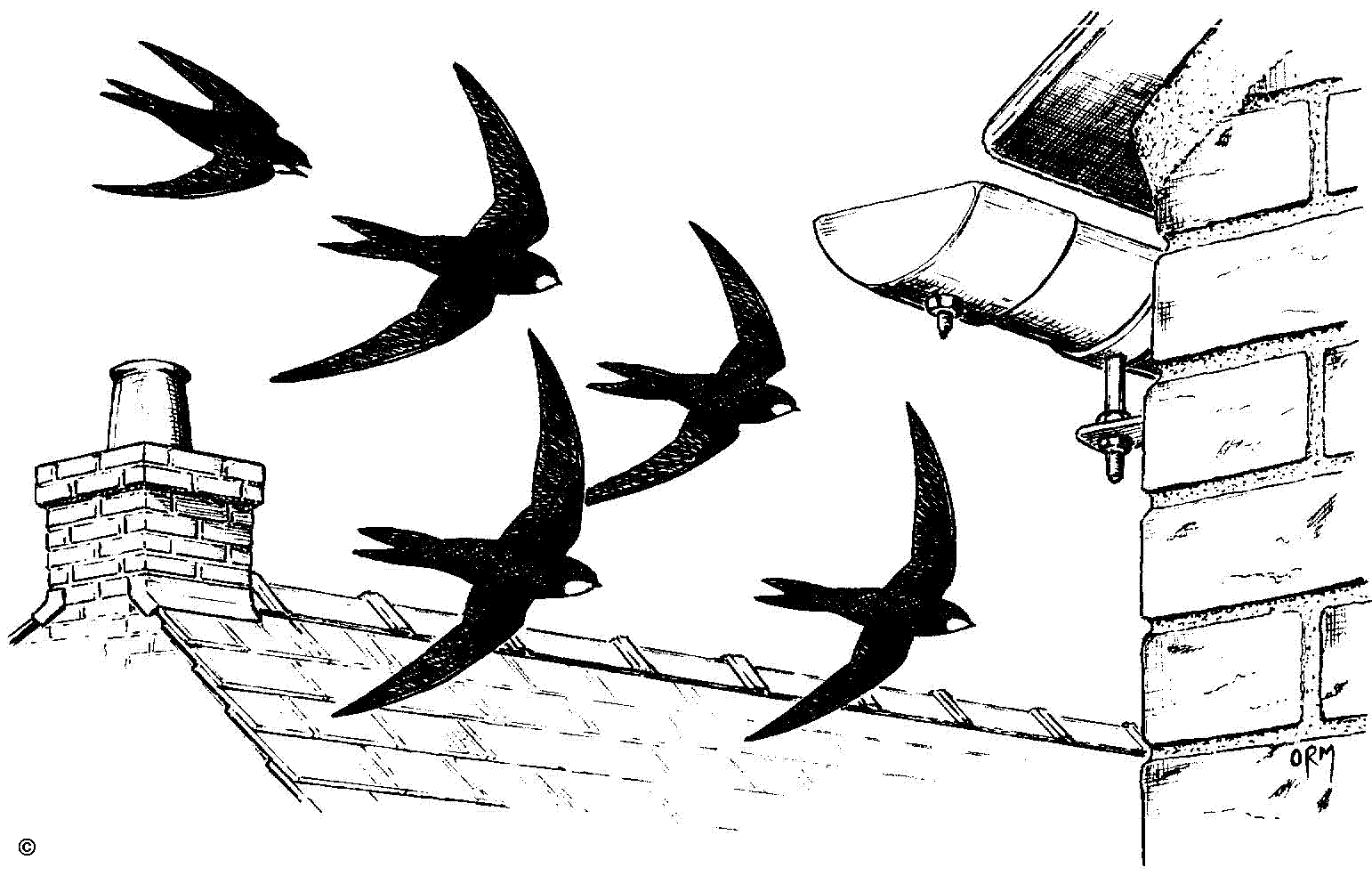
If we are going to protect existing Swift colonies, we need to know where they are and how many breeding pairs there are. Easier said than done! It's not difficult to locate a Swift colony, the giveaway is the screaming parties round the chimney pots (If the Swifts are very high, they are feeding, and not necessarily associated with nearby buildings). A further clue is the way prospecting birds will swoop towards, and often "bang" against, potential nest cavities under eaves or tiles, or against crevices in brickwork.

Saturday, 26 February 2011

How big is a Swift nest-box?

Update 28th July 2012
We have usually assumed that Swifts prefer larger spaces to smaller spaces. However, some recent experiences seem to indicate that smaller boxes may be OK. 
Our installation of air brick liners in the old factory site in Brook Street St Neots gave us 12 nest places with a floor area of 200 x 175mm and a height of 100mm. At least two pairs of Swifts took up residence, and one may have produced a chick.

We recently examined the contents of the nest-boxes in St Mary's Ely. We compared two basic sizes of box: 

  • 16 narrow boxes are  100mm x 300mm (a few widened to about 125mm) 
  • 80  wide boxes are 200mm x 400mm (most of these only recently installed).

In the narrow boxes we found 9 boxes containing 15 chicks = 1.67 chicks per box
In the wide boxes we found  9 boxes with 14 chicks = 1.75 chicks per box

The narrow boxes have been installed for a longer period than the wide ones which is why occupancy rates are different. Now, we do not know how many other boxes had failed; another uncertainly is that the narrow boxes have entrances in the floor, whereas the wide boxes have entrances in the side, but it seems that swifts are as productive in narrow boxes as wide ones.
Of course, we need to collect more data, but perhaps we need to be a little more open minded about small and narrow boxes.


Posted by Dick Newell:


Swifts can, apparently, nest in anything from a House Martin's nest to a whole roof space though the success rate in the former may be questionable. They nest in holes in trees in Scotland and in northern Europe in what must be quite confined spaces. Examples of successful commercial nest boxes have internal dimensions like 140mm x 300mm floor area, height 140mm. Erich Kaiser's very successful colony in Kronberg, Germany, has large nest-boxes about half the size of a tea-chest.

Wednesday, 23 February 2011

Why use a nest concave?

Posted by Dick Newell:
click to enlarge
When Swifts find a natural nesting place they will usually find a flat surface on which to nest. The first thing they need to do is to construct some sort of nest to stop their eggs rolling about. Most Swifts, when they first find a new nesting place, do not breed in that season, they spend their time building a nest ready for the following season. However, if the Swifts find a concave shape already in place, then this increases the chance that they may breed in that first season (per Erich Kaiser).

Saturday, 19 February 2011

I am a Swift - I am in trouble

'I am a Swift' is a delightful booklet, suitable for children from about 6 years old, and it tells the story of the plight that Swifts face and what can be done to help them. 'I am a Swift' comprises 28 pages, full of information and stories about Swifts.


Click here for flipbook
Contact actionforswifts@gmail.com for more information.

Friday, 18 February 2011

How to make a Swift Mobile

Here is a great idea for kids. OK, the kids may need a little help, but the resulting mobile will really show them what Swifts look like and help them gain an appreciation of these great birds. All you need to do is to download the instructions, then the template of shapes to cut out and you are all set up.

For templates with labels for wings down, wings flat and wings up configurations, click on these links:
Wings down  Wings flat  Wings up
Then in Googledocs, hit File > Download, or File > Print (PDF).
After cutting out the pieces, write the labels in brackets on the other side of the card. Then score, fold and stick matching labels together.
[UPDATE Nov 2015: We have uploaded a version with yellow lines suitable for printing on black card - download]