Saturday, 7 May 2016

Some implementations of the Cambridge Swift Box System

The Cambridge Swift Box System is a method of installing internal nest boxes, by replacing a whole brick or half brick with a cast insert containing an entrance hole, with a nest box inside the building.  

We have now installed boxes in 8 houses with pleasing results in all cases (see examples - scroll down to see all examples). It is particularly straightforward in solid walls, at roof space level, where the headers go all of the way through the wall. Such walls typically have soft lime mortar, so removing a header is an easy job. Below are some pictures of the results from 3 such projects. In all cases, the boxes inside the roof space are a simple plywood construction, with a hinged inspection door.

The first example 
This came about when we were walking down Haddenham High Street and we spotted an old unused Zeist Swift box on a gable end. The owner was in the garden, so we engaged in conversation. There were 3 missing bricks in the wall above the Swift box, so we made the obvious suggestion to her, resulting in 3 new nest places for Swifts, instead of the Zeist box.
[Update 2022 - all 3 boxes are occupied]

The original unoccupied Zeist box, exposed to sun and rain,
with 3 bricks missing from the wall

3 entrance pieces inserted
Close up

The second example
This is right next door to the first example, and was the reason we were walking down Haddenham High Street in the first place
[Update 2017: 2 pairs of Swifts have moved into the boxes on the right]
The whole gable end, with 2 sets of 3 entrances
[UPDATE 2018: all 6 nest boxes are occupied!]

Close up of 3 entrances

The third example
This is an old vicarage in Longstanton.
[Update 2017: the first pair of Swifts has moved in]
[Update 2022: 3 boxes are occupied by Swifts and 1 by Blue Tits
6 entrances virtually invisible from a distance
[UPDATE 2017: 1 box is occupied]

Close up
#inserts
#Cambridge

An idea that has not worked (yet)

In 2010, we installed 3 Swift boxes in St John's Church, Bury St Edmunds. While we all like publicising our successes, it is probably informative to publish the odd failure as well. Despite playing attraction calls every year, with Swifts showing interest and banging the nest box entrances, by 2015, we still have no boxes occupied.
[UPDATE JULY 2016: I suppose it was tempting fate giving this post its title, as the re-engineering described below has resulted in 2 pairs of Swifts raising 2 chicks each]
[UPDATE JULY 2017: the boxes were increased to 12 this year, all of which show some evidence of Swift activity: 4 had chicks, 2 had eggs and 1 well feathered when last inspected] 
[UPDATE JULY 2018: a further 48 boxes were added bringing the total to 60 boxes. When inspected, the number occupied was 25 - a major increase]
[UPSATE JULY 2021: 40 boxes are occupied by Swifts!]
[UPDATE JUNE 2024: 58 out of 60 boxes are occupied by Swifts]


The west side of St John's, the boxes are
near the bottom of the right side
The church has a very high tower, but the windows are not louvred, they have a trellis pattern with a  large number of diamond-shaped holes, with netting on the inside. The entrance to each nest box is an equilateral triangular tunnel, with sides 65mm. This should be enough for a Swift to enter, but clearly they don't like the look of it.

Despite our attempts to make the entrances stand out (literally), it could be that the profusion of holes confuses the birds.

We have decided to re-engineer the entrances, by removing the floor of the triangle, so that the birds have a whole diamond available.

We have also added a small ramp below the entrances to the boxes (see last picture below).

If we could get Swifts into these boxes, the potential of this church is enormous. The pictures below show what we have done.
3 entrances, before re-engineering. The 'ladders' below the entrances were added later.
Close-up of 1 entrance

The 3 boxes rest on the floor


A re-engineered entrance with the entrance
floor removed and a ramp below the box.
xxx
The re-engineered entrances reinstalled

The crazy flying birds of Toulon

This story was sent to us by Katherine Dubourg, volunteer and Vice President of the LPO PACA, in Toulon. It is the story of a concerned set of individuals who are doing something to reduce the destruction of Swifts' nests in Toulon. There may be ideas here for some members of the Swifts Local Network in the UK.

(Text translated by Jake Allsop)

SEASON 1: 2015

CENSUS OF COMMON SWIFT BREEDING SITES

As elsewhere throughout the Mediterranean coast, three species of swift are present in Toulon in the breeding season:
  • Common Swift (Apus apus) is the most common and most abundant; it nests throughout the city.
  • Pallid Swift (Apus pallidus) is rarer. In Toulon, it nests in the structures of the old port, in naval buildings, in the Bd de la République, and on the cliffs along the coast path.
  • Alpine Swift (Apus melba) nests in the cliffs of Mont Faron and the coastal path.
A Common Swift over Toulon
Photo André Schont (LPO PACA)
A Common Swift over Toulon
Photo André Schont (LPO PACA)
In Toulon, as almost everywhere else, mandatory renovation work is carried out every 10 years, but the restoration or rehabilitation of old buildings does not take account of the swifts' presence or their needs. Given that every single nesting cavity is filled in or destroyed, we were aware that the future of the birds was under threat.
And that is why the LPO PACA and its local volunteer group decided to act in Toulon to ensure that the protection and enhancement of this iconic species so closely associated with our built environment, should be implemented in all works of urban renewal.
In Toulon, which is the third city in the Provence Alpes Côte d'Azur region after Marseille and Nice, an ambitious urban renewal program of the historic centre has been ongoing for several years. There is a phased programme for the renovation of all districts, ranging from simple facade cleaning and restoration to demolition and reconstruction of entire blocks. And of course what concerns us is the risk of missing opportunities to provide compensatory nesting accommodation for swifts.
After two years of contacts and meetings, several City Hall services have responded, at first listening politely, then curious to know more, and finally showing great interest in the project. They include: Sustainable Development; Sustainable City; Protection of Wildlife; Urban Renewal; and Var Development Planning (A combined private and public consortium charged with the rehabilitation of the old centre of Toulon).
BREEDING CENSUS (May-June 2015).
Before a plan for protection can be formulated, it is necessary to gather precise information about the existing situation. For this purpose, a census of swift nesting sites in Toulon was proposed, which in turn led to a project involving a number of participants.
ACTIONS
  1. LPO PACA produced a leaflet "Campaign to census breeding Swifts in Toulon". About a thousand were distributed to residents, tourist offices, retailers, restaurants, schools and to various other public places. Some volunteers even went from door to door in the town centre to tell people about the reasons for the campaign.
  2. A conference on "Swifts in the Toulon Built Environment"was led by Katherine Dubourg. (Director LPO PACA) in Toulon.
  3. Katherine also participated in two radio programs on the swifts of Toulon and the Breeding Census Campaign 2015 (RCF and France Bleu Provence), France Bleu Provence also did a life outside broadcast on the arrival of the first swifts.
  4. In the end, nearly 30 people volunteered to participate in the original operation. And even though not everyone was available during the two months of the census, there were regularly between 5 and 12 people, getting out twice a week, on Mondays and Thursdays in late afternoon, near the Cafė Culture in the old city centre.
  5. Teams of 2-3 people were then formed. Armed with a section map* and a tally sheet**, they spent three hours with their noses in the air and their eyes open looking for and noting evidence of the birds' presence.
  6. * The local authority topography department kindly provided us with maps of the city showing streets and properties. The old center was divided into eight sectors.
  7. ** The tally sheet recorded the following information: the name or names of participants, weather, sector number, the name of the street, number of buildings, the property reference, the location of nest cavities or nests (eg 3rd pigeon hole to the left behind right gutter), times when birds observed entering or leaving cavity, and the number of A/R observed).
  8. After each survey, data were entered in an Excel spreadsheet, which was then submitted every weekend to the City Hall and to Var Development Planning.
  9. Once the survey was completed, all data were posted to http://www.faune-paca.org/
SUMMARY OF RESULTS
The census campaign ran from 21 May to 11 July 2015.

Although the Swifts are still present in the city in mid-July, most volunteers were exhausted. No more formal counts were done, but for some of us, observations continued until the end of September, especially for Pallid Swifts, which are the last to leave.

20 sessions of volunteer counting
250 hours of prospecting
384 active nests identified in the old center

In the old centre of Toulon, the majority of nests are in old pigeon holes (there are many old buildings in Toulon) on façades, behind guttering, under tiles and in the frameword of metal shutters, in delapidated walls of some historical monuments such as the Royal Tower, which is an historical monument at the entrance to Toulon harbor.

Location of nests in the Alexander Garden

FOLLOW-UP IN 2016
The Mayor of Toulon in cooperation with LPO PACA has just published a leaflet: "Protection of Swifts in Toulon”, which will now be included by the Urban Planning Department in every future planning application (PIX credit: Swift Conservation). It is also at posted on the official website of the town hall: http://toulon.fr/martinet
A meeting of the various stakeholders - buildings, businesses, architects, public and private donors - should be organized soon by Var Land Development and the City Council to ensure that everyone is made aware of the need for swift conservation in the city.
The Toulon Provence Méditerranée consortium (TPM) is committed to installing several temporary nest boxes on the site of the former Chalucet Hospital to provide accommodation for Swifts dislodged last year during demolition work. These will be installed before the birds arrive.
The Bouygues Immobilier company and ELAN Group carriers
http://cibi-biodivercity.com/biodivercity have also agreed to incorporate swift nestboxes in buildings in the Eco Font-Pré area which are currently under construction (800 homes of 30,000 m2).

For our part, LPO PACA and our volunteers will resume our surveys in several neighborhoods that were covered last year because lack of time, for example, the Montety district, which is part of a sprawling urban regeneration project. Forty swift nests were observed last year there in just three nights of observation.

A conference on Swallows and Swifts will be presented by Elise Cougnenc (LPO PACA) on Tuesday, March 30 at 17:45 at Peiresc Collège de Toulon tomark the beginning of SEASON 2 Swifts Toulon.

Katherine Dubourg
Vice President LPO PACA
Toulon
Installing a Schwegler treble box


Wednesday, 30 March 2016

Je suis un martinet est arrivé!

Front cover (click to enlarge)


We are delighted that our booklet for children, 'I am a Swift - I am in trouble' by Helen Hodgson has been adapted and translated into French. 

This initiative was undertaken by Carolyn Knowlman, who writes:


Chateau Amboise
The background photo of the screamers is the Chateau Amboise in the Loire valley, where, as elsewhere, we realised that swift nest sites were being lost as the town gets poshed up and new buildings are unsuitable. 

The group got off to a great start with a very well attended meeting with Marcel Jacquat & Edward Mayer speaking. We are very appreciative of their help. 

So far this year the group has put up around 50 boxes in and around the town.The Mairie (town council) has got involved and put up boxes too. Next year the aim is to do more with local schools.

The booklets are available by contacting Carolyn via email at Ctlhk@wanadoo.fr
The suggested donation price is €2 Or £1.50 Plus p&p.

Friday, 25 March 2016

Another flat-topped roof installation in Tel Aviv

This is another useful case study showing how to add a large number of nestboxes to a protected building, without compromising its appearance. It is the same concept as this project. There must be many flat-topped buildings where this idea could be implemented. It is unobtrusive and access is straight forward should any maintenance be needed. Swifts can be slow to occupy the middle boxes in a row of regularly space boxes, but in this case, the aesthetics required a symmetric arrangement. The Swifts will figure it out eventually.

Amnonn Hahn writes:

The project objective was to build a large Swift Colony. At 15 meters long, it contains 36 nesting chambers. It was installed on the first building in the area long before the City of Tel Aviv was founded. It was built in 1856 by UK Jews who bought an area of 20 acres to serve as the 1st Agricultural Study Centre. It was called "The Farm House".

The Ottoman Empire used it as a "Watch Station" to control the passage between the port of Jaffa and Nablus. The British Army had stationed one of its units there after WW1. The area was sold to the founder of the Israeli Electrical Company (IEC) Mr. David Rothenberg who built the 1st Electrical Power Station in that era. IEC became one of Israel’s largest & strongest companies. In 1968 IEC decided to move the centre of its Board of Directors into this building and it became the first conserved building of Tel Aviv.

The area is right in the centre of Tel Aviv with houses over 100 years old being conserved under the supervision of the City Conservation Dept.

The project was implemented in cooperation with the City Conservation Dept who supported the idea of installing the "Swift Colony" on this "Farm House". They officially approved the Swift Colony design.

The project was also achieved in cooperation with IEC, The Society for Protection of Nature in Israel and The Hoopoe Foundation.

"And the rest is history".

36 boxes neatly installed

36 boxes ready for installation


Before installing the 'sunroof'
Detail of the 'sunroof'


A tweeter built in to one of the nest boxes.


The detail, left, is a 'starling baffle', designed to deter the invasive Vinous-breasted Starling


Everything is ready for the opening ceremony.


#temperature
#parapet

Friday, 4 March 2016

Beijing Swifts in Chinese Media

One of the intended consequences of the Beijing Swift Project was to further raise awareness of nature in general and Swifts in particular in China.

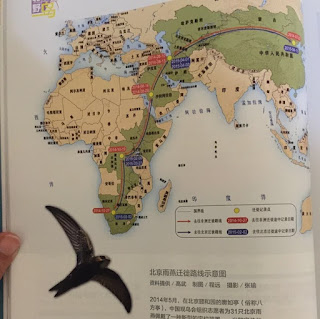
In the February 2016 edition of the Chinese outdoor magazine "Forest and Humankind", Beijing Swifts make it onto the front cover and are the main story!


Front cover
The article is about the Swift's lifestyle with the migration as part of the story.

We include scans of the front page, with an accomplished painting of Swifts, and a rather nice map highlighting all of the countries visited by Swifts on their epic journey from Beijing to southwest Africa.

You can also read previous posts about the Beijing Swift Project

Schematic map showing the route from Beijing to southwest Africa
and back, including all of the countries visited highlighted in green.

Wednesday, 2 March 2016

New Swift tower in Poland

We have been sent pictures of an innovative Swift Tower in Poland designed by Warsaw architect Marcin Grabarczyk, in one of Warsaw's most beautiful parks situated near the Vistula River: Kamionkowskie Błonia Elekcyjne Park. Structural engineering was by Krzysztof Drzazga.

These towers are the result of a design competition organised by STOP, the Warsaw Society for the Protection of Birds on behalf of the City of Warsaw in 2012. The project was completed in January 2016. Two steel towers, 7.94 metres high, each contain 32 nest boxes on the north and east facing sides, with solar panels for attraction calls on the sunny side. The nest boxes are made of wood impregnated with linseed oil.

The plan is to build more towers in Warsaw,  as, in many other places, Swifts are losing their nest sites due to building renovations and insulation.

All of the pictures below are by Marcin Grabarczyk (click on them to enlarge)

The towers on a cold winter's day with the education board beneath

The towers stand at the top of a slope leading down to the water
Solar panels on the backs of the towers

Closer view showing circular entrances


Friday, 26 February 2016

First deployment of Model 30 Swift boxes

Since 2008 John Stimpson has made and sold nearly 7000 over 40,000 Zeist Swift boxes. The Zeist design is suitable for positioning under broad eaves. In exposed positions, with its flat roof, it would allow predators to perch and, made of plywood, will not last if exposed to sun and rain. Thus, we have provided him with a design suitable for a wider range of situations. John is now also supplying boxes made to this design.

The new model is called the 'Model 30' - as all angles in it are 30°. It has borrowed an idea from Maurice Wilkinson, who made his DIY Swift boxes out of PVC, commonly used for fascia boards. With its double thickness PVC/plywood roof (21mm of material in total), with a slippery white reflective surface,  the Model 30 should make life difficult for predators and it reflects sunlight.

The design is available as a flatpack, so it makes an ideal gift. All it requires is a cross head screw driver to insert the 14 screws needed to hold it together.

We are now making our first deployments of these boxes in more exposed positions.

John Stimpson contact details: 
Email: j.stimpson1@btopenworld.com


The first 4 Model 30 boxes installed on an exposed gable end in Fulbourn, Cambs
[Update: one of these boxes was first occupied in 2017]
[Update 2018: 3 of these boxes are occupied]


Model 30 as a flatpack


2 boxes assembled


UPDATE 2016:

An attractive arrangement of Model 30's installed in 2016.


#temperature

Wednesday, 17 February 2016

Maidenhead, Marlow and Cookham Swift Group

Another heartening example of a local initiative to provide more accommodation for Swifts.

by Jan Stannard

This month has seen the start of our area’s Swift box initiative, with the first boxes made locally by volunteers, along with attraction call systems, bought as components and assembled. So far we have agreement for about 40 sites to install boxes.

These are mostly families with suitable houses in areas where we know there are existing Swift breeding sites. These are clustered in streets within the three towns so that they should form ‘loose colonies’. We have already surveyed every single location to make sure it is suitable for swifts in terms of flight path, predator access, aspect and overall height.

On residents’ houses we are installing external boxes because people regard internal boxes as too difficult and too costly to put into their houses. The design is based on Mark Glanville’s twin design, and are sold at cost price (£25 for a twin box). 
Mark Glanville's twin compartment box
WoodStone® Swift Nest Box
In some locations, for example where a cherry picker will be used, we have recommended Woodcrete swift boxes from CJ Wildlife for extra durability.

The property owners have readily agreed to have a sound system, which we are providing ready to use at a cost of £26 (cost price). This comprises a mini amplifier, a tweeter, an SD card with swift calls, a power supply and a suitable length of audio cable (see here).

In addition to domestic properties, we have persuaded the clergy and wardens of two local churches to put in 4-6 boxes in their towers. 

Lastly, we have two new large colony installations: Swift House by McCarthy & Stone (28 internal boxes) and Premier Inn Maidenhead (20 internal boxes).

In total, there will at least 120 swift nesting places if all goes to plan.

The Maidenhead, Marlow and Cookham Swift Group was founded in July 2015 and now has 80 members.

Our website [www.helpourswifts.org.uk], 
Facebook page: here.
Installing 2 double boxes

Sunday, 14 February 2016

Swift Nestboxing in Tashkent

We report regularly on the activities of our friends, Elena and Pavel, in Tashkent (Uzbekistan}, for they do so much, not only in the field of rehabilitation, but generally to raise the profile of wildlife conservation in their city and country. To this end, they decided to take part in a nestbox scheme in the city - nestboxes, especially external ones, are highly visible and make a public statement.

A local building firm, Murad Building Company, had already produced nestboxes for various species as part of a local conservation initiative. Elena and Pavel had a meeting with Murad and proposed that they should add a Swift nestbox to their suite of boxes. 


Of course, this was virgin territory for everyone, and we were happy to provide information on materials, design and construction for an external Swift box. The key points were to ensure that the boxes were proof against sun and rain, and that the optimum size should be floor area roughly 17cm x 30cm, height, 15cm.

As to materials, we all held our breath, but the results are spectacular. The boxes have now been delivered by Murad. They are made from good quality planed timber and of a thickness that gives them good insulation.


After a couple of false starts, Murad came up with the goods. They produced a 100 boxes in quick time!

The next step is the mounting of this first batch of completed boxes. Elena and Pavel met with Roman Kashkarov of the UzSPB, and got agreement for boxes to be placed on the UzSPB building, which is high and suitable for Swifts. This will be done ceremonially as part of the Society's "Common Swift Year 2016".

Their next step is to find as many local people as possible who would like to have Swift nestboxes on their property.

What is really heartening about all this is the recognition that our friends are getting for their work. They are now in the process of constituting themselves formally as the Centre for the Rehabilitation of Wild Birds in Uzbekistan, and have an application in to the GEF Small Grants Programme, which was established in 1992, the year of the Rio Earth Summit. 


Elena and Pavel, we wish you well!

UPDATE: The following pictures show the boxes installed:


Saturday, 6 February 2016

More swift boxes in Milton, Cambs

We already reported on Clarke Brunt's Swift boxes, where he had 6 breeding pairs of Swifts in 2015. Our recent successes with installing internal nest boxes in roof spaces convinced Clarke that he could do the same. Although there are no new ideas here, this is another example of a well executed installation.

by Dick

The location is perfect, right on Milton High Street and opposite the Lion & Lamb public house, where people sit out on summer evenings. The Lion & Lamb can expect increased custom from Swift nuts this summer and all future summers!

The project is very similar to what we did in Newnham. Again it was a Victorian solid wall, where removing a header was an easy way of making a hole through the wall. The same cast moulded concrete inserts were used for the entrances.

This time the boxes were made with hinged doors on the back, but were constructed so that these can easily be replaced with perspex backs if so desired.

This project was implemented by Bill Murrells and Clarke himself, with a bit of help from me.

The following pictures are self explanatory.

[UPDATE 2018: 4 of the 6 boxes are occupied]
The view from the Lion & Lamb
3 entrances on the right hand side
Detail of a single entrance
6 boxes neatly installed
3 boxes on left side of gable
Close up of a single box


#inserts
#Cambridge

Friday, 5 February 2016

Swift nest box 1908-09 style

The February 2016 issue of British Birds magazine contains a fascinating letter by Richard Porter and Graham Madge about the value of nestboxes to bird conservation (Brit. Birds February 2016).

by Dick Newell

The letter references a leaflet published by the RSPB over 100 years ago, in 1908/09, which includes nest box designs for the usual tits, woodpeckers, flycatchers, and Wrynecks (now extinct in the UK) and also a very nice looking design for  Swifts!

Swift box cropped from the leaflet below


In those days, you could buy a Swift box for 2 shillings (10p then, £10.75 in todays money).

Recorded bird calls had not been invented then, so one wonders what success rate they had with these boxes.

The BB article asks the question whether nest boxes have had any conservation impact on various species? The 3% per annum decline on a Swift population of 87,000 pairs (in 2009) (Musgove et al 2012) could mean that ~2600 pairs of Swifts are being lost each year. As the 87,000 is almost certainly an underestimate, and given likely occupancy rates, then 3 or 4 times 2600 nest boxes may be needed just to stand still.

If the mass house-builders get on board with the idea of incorporating nestboxes in every suitable gable end, then this should be doable.

The inspiring RSPB leaflet, published in Bird Notes and News 1908/09 is here:


References
Musgrove A., Aebischer N., Eaton M., Hearn R., Newson S., Noble D., Parsons M., Risely K. and Stroud D. 2012.
Population estimates of birds in Great Britain and the United Kingdom. British Birds 106 * February 2013 * 64-100
Porter R.F. and Madge, G.  2016. Boxing Clever: the value of nestboxes to bird conservation Brit. Birds, Letters, 109: 122