Tuesday, 23 October 2012

Cambridge AfS End of Year Report 2012

This report describes what we in Cambridgeshire have been up to this year, 2012. The Cambs team includes Jake Allsop, Guy Belcher, Helen Hodgson, Bill Murrells, Clarke Brunt, Alan Clarke, Rowena Baxter, Judith Wakelam, Dick Newell, Vida Newell and Bob Tonks


This has been a year of mixed fortunes. As far as we can tell, occupancy of all nest boxing schemes that we know of has either remained stable, or increased since last year.


St Neots in Bloom nomination
So the adult birds turned up, but then the dreadful summer weather meant that breeding success was below normal, with reports of eggs thrown out of nests and of chicks dying. Alongside this, the take up of boxes at new sites has been unusually slow.

We were delighted that our projects in St Mary the Virgin and the old Brook Street factory site in St Neots were nominated for an award by the 'St Neots in Bloom' Committee.

Nest-box progress
Large/public buildings
At Edgecombe flats, Cambridge, the 71 swift nest-boxes have been very successful with House Sparrows. However, 2 pairs of Swifts bred in the boxes outside Peter Glass's flat. We hope to install another attraction call player ready for 2013.

The 12 boxes built into the eaves of Ekin flats, Cambridge, in 2010, were not monitored in 2012.

At Birdlife International headquarters in Girton, a single pair of Swifts returned again to breed, raising 2 chicks and providing entertainment on a TV monitor in the kitchen. We still await more pairs in the other 7 boxes.

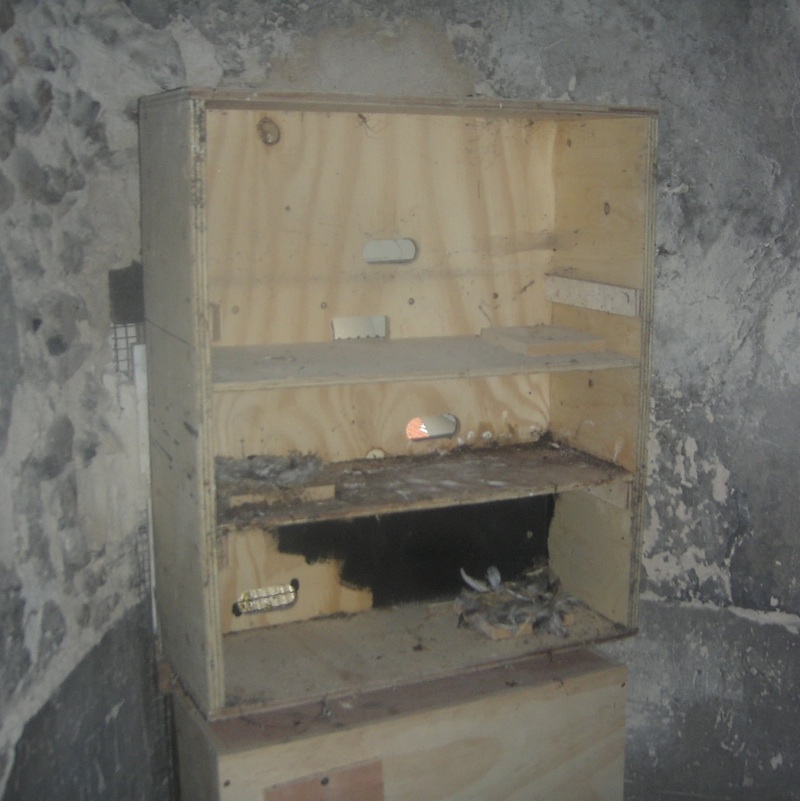
Built in nest boxes at Fulbourn.
Photo Rob Mungovan
Although our involvement in the Swifts housing estate in Fulbourn has been minimal, we are delighted to hear that about 30 of the new nest-boxes there are occupied. Swifts preferred built in boxes to those mounted outside. It is worth reading this RSPB case study. Credit to Rob Mungovan.

We were pleased to be able to contribute an idea to reduce the entrance size of Schwegler 1MF boxes to exclude Starlings.

Schools
At MiltonRoad Primary School, early in the season, birds were seen entering 4 of the 6 boxes, but we are only sure of them becoming established in 2 boxes, at least raising one chick in the camera box.

Domestic dwellings
Nest-boxes installed on people's houses in previous years included Bob’s house in Milton, where 2 pairs bred, but one failed and the other raised 2 chicks. Clarke Brunt , also in Milton, increased his established pairs from 1 pair in a nest-box with a second pair in a hole that he had made in the eaves of his house.

3 Boxes on a house in Chesterton
Bob and Mary Osborne in Histon had successful breeding, with 2 chicks raised on top of a House Sparrow's nest in their camera box.
Bob Humphrey and Neil Roberts in Landbeach, both had pairs returning to their boxes.

Dick's colony, also in Landbeach, increased from 7 to 8 breeding pairs, but only 4 pairs succeeded in raising chicks, one of which was the new pair. The geolocator bird was retrapped revealing where it spent the winter. A colony of bees occupied one box at the end of the season.

Linda Jarvis in Cambridge had her first occupant of her nest-boxes to add to the pair already nesting in her eaves.

Rowena attracted Swifts into her boxes in Dry Drayton, but it is not certain that they became established.

Churches
Although we did not continue with attraction call playing at St Andrews, Oakington this year, we were disappointed that the 8 boxes in the belfry remained unoccupied. We have now installed an extra 12 boxes at the tops of the louvres on the south and west sides, and we hope to resume attraction call playing in 2013.
At St Mary the Virgin, St Neots, the occupied boxes increased from 2 to 4, we hope to expand the number of nest boxes in 2013.
All Saints, Worlington
Photo Judith Wakelam
At All Saints, Worlington in Suffolk, there was an increase from 2 occupied boxes in 2011 to 7 occupied boxes this year. There are now 18 nest-boxes in the church.
At St Mary's Church Ely, we found a total of 30 boxes containing nests, of which 20 boxes contained a total of 31 chicks, and 3 boxes still contained eggs. This is now a major colony.

Swift Towers
We were disappointed that we failed to attract Swifts to occupy the Cambridge Swift Tower. Attracting Swifts into new boxes has proved particularly difficult this year. Apart from this, the tower attraction call player proved to be unreliable requiring attention on a number of occasions.
A number of other projects are still waiting for their first occupants.

New projects
We were involved one way or another in many projects, including the following by providing nest-boxes, Box of Swifts attraction call players, or advice:

4 double boxes in St John's chapel
Photo Bob Tonks
St John's College Chapel: 8 nest-boxes installed (plus 2 boxes on the groundsman's house)
Wessex Place, Cambridge: 34 nest boxes installed
St Neots Brook Street factory site: 12 Swift bricks installed, at least 2 occupied
Shirley Primary School: 8 nest-boxes installed
The Ace foundation, Stapleford: 8 nest-boxes installed
The School House, Chippenham: 6 nest boxes installed, 1 box occupied
Colville Road, Cambridge: 2 Swift bricks installed
Bob's next door neighbour, Milton, Cambridge: 4 nest-boxes installed
John Clamp and neighbour, Newnham, Cambridge: 8 boxes, 1 box occupied on John's house
Lackford Lakes, Suffolk Wildlife Trust: 12 boxes, built by local volunteers
St Andrew's Oakington: after the end of the season, we added another 12 boxes to the 8 there already.
Packenham, Suffolk, Sandy Jackson's property: 3 boxes installed

We advised on the installation of 7 boxes in St Catherine's, Litlington and 4 boxes in St Leonard's, Southoe.
We were honoured to be asked to design some Swift cabinets for St Rémy Church, Molenbeek, Brussels.

A number of these projects were implemented late in the the season, ready for 2013.

Presentations and workshops
We gave presentations to the Cambridge Natural History Society and to the Suffolk Wildlife Trust. This was followed up by a tour of potential nest-boxing sites in Suffolk.

We ran a workshop for the eco group at Shirley Primary School where 12 children painted Swift nest-boxes before installation on the school. The children also completed a Swift quiz.

At Fulbourn Primary School, John Willis made arrangements for us to give a Swift presentation to the whole school assembly, the children made Swift mobiles and nest concaves out of Modroc.

Innovations
Sound equipment
In our last report we mentioned the development of the "Box of Swifts” attraction call player. In 2012, we sent out 30 of these. Although a small number had intermittent faults, feedback was positive; people found them easy to install and to operate. On the whole, they performed well, with many people reporting Swift activity around their boxes, but occupancy rates were disappointing, with only 3 places with new occupants.  This contrasts with previous years when we have had a higher success rate. We believe this is explained by the weather.
The Box of Swifts has a component cost higher than we would like, and it took about 2 hours of skilled soldering to assemble. This we decided we would not repeat for 2013, so we have a new plan with a lower component cost, no soldering and with a more powerful amplifier. After beta tests are complete, we will describe it on this blog - watch this space!

Nestboxes
Boxes for different sloping eaves
For nest-box design, we have found that a format similar to a Zeist-box, but with a vertical front has suited many situations where the boxes fit nicely under eaves that slope one way or another, and where a standard production model, with a horizontal top, would fit less well. Examples include Milton Road Primary School, Shirley Primary, Ace Foundation, Chippenham, Wessex Place and Lackford Lakes (see links above).


Air brick liner Swift brick
We are particularly pleased with the air brick liner Swift brick which was invoked for an emergency situation in St Neots, and they were also deployed in Cherry Hinton. We are in the process of making a short production run of 20 units. They are low cost and easy to make with the right equipment.


Rehabilitation
Judith reports that a difficult season had produced more casualties. 
3 successes. Photo Judith Wakelam
She reared and released 11 nestlings. Of 6 adults and one free-flying young bird, she rehabbed and released 4; the other 3 had to be euthanized
In addition, 4 adult Swifts were rested and released by their finders after contacting Judith for advice.


2013
In 2013 it is our intention to focus on consolidating the projects we already have underway rather than make a push for new projects. We would like to increase the percentage of nest-boxes occupied, which currently stands at about 1 in 4. Ensuring consistent attraction call playing from May to July should achieve this. This will be made easier with the further deployment of easy to install and easy to operate sound equipment.

You can also read Cambridge AfS End of Year Report 2011

Sunday, 21 October 2012

St Andrew's Oakington

Written by Dick

We installed 8 nest boxes in 2 cabinets on the south side of the belfry in St Andrew's Oakington in 2008. As it is difficult getting access to mains power, we did not play attraction calls until 2011, where our Box of Swifts made this feasible. This resulted in a lot of Swift activity on many days near the nest-boxes, but no Swift succeeded in finding an entrance. We were hopeful that the birds from 2011 would persevere in 2012, but alas no success this year either. There are two pairs of Swifts nesting precariously in crevices on the sides of the louvres in the south and west sides.

St Andrew's should be a great success. Years ago it had a vibrant colony on the south side of the chancel, until roof repairs excluded them.

Fronts and backs of cabinets. The outsides are darkened 
rendering them virtually invisible. Entrance positions
are dictated by the stonework. The 3 chambers with nest
concaves on the west side did not have concaves on the 
south side, and vice versa.
Since the original cabinets, we have learned that Swifts' 1st choice is somewhere near the tops of the louvres, their second choice is somewhere near the bottom. Our original cabinets are in the middle.

So, with the permission of the PCC, we built 2 more cabinets for the tops of the louvres on the south and west sides. The triangular shape fitted the batons that support the bird-proof netting.

We debated whether to put 3 large boxes in each triangle or 6 smaller boxes. As the existing 2 pairs of Swifts nest in spaces very much smaller than this, we went for 6 boxes in each cabinet.

Boxes in the south side. Photo Bob Tonks
The floor area of each chamber is a minimum of 220mm wide by 275mm deep. The headroom in each chamber is 100mm.

Holes were made in the netting by cutting the sides and top of a rectangle with wire cutters, then bending the wire inwards and downwards. This conveniently blocks any small gaps below the entrance.


Boxes in the west side. Photo Bob Tonks
Nest concaves were placed in half of the boxes, in the hope that we can collect more data on Swifts' preference for this facility.

We did not provide inspection doors, as we think that, should we wish to inspect the boxes before the end of the breeding season, we can do that by removing the whole back, then moving it up, left and right to take a peep at the contents.

We intend to resume playing attraction calls in 2013.

St Andrew's, Oakington: Swifts once nested under the eaves on the south side of the chancel
 © Copyright John Sutton and licensed for reuse under this Creative Commons Licence

Thursday, 11 October 2012

Treble Zeist with a double roof

UPDATE August 2012: 1 pair of Great Tits occupied the box on the left, followed by a pair of Swifts which successfully raised chicks.
UPDATE 2014: Swifts nested in both the left and right boxes
UPDATE 2015: These 2 pairs returned and bred. 3 new boxes on another wall were not occupied
UPDATE 2016: All 3 original boxes occupied by Swifts, tweeter moved to 3 new single boxes.
UPDATE 2017: All 3 original boxes and 1 new box occupied
UPDATE 2018: Same as 2017

Contributed by Dick

Some old friends asked me what to do about Swift boxes on their Cambridge house, which is located within a 100 metres of a substantial Swift colony in Chesterton Road.


Click to enlarge
The house has no eaves, and the only available walls face south and east, so we decided to place a row of boxes on the east facing part. Both the sun and the rain could hit the top of the box, with the gutter providing little defence.

The Zeist format seemed most appropriate, and to use space efficiently, we built a single box with 3 chambers.

It has a double roof, made of 2 sheets of  marine ply separated by batons. The roof assembly comes off in one piece by removing 4 screws along the front into batons screwed to the inside of the roof.

Computer model showing how the roof assembly is fitted

The whole thing was first coated in clear Ronseal, followed by a coating of decking oil, which should mitigate the effects of ultra violet light.


Monday, 8 October 2012

Modern buildings not Accommodating to Swirling Swifts

Brian Cahalane alerted us to this well informed and inspiring article about Swifts in Ireland, written by Michael Viney in the Irish Times. We think that it is worthy of a wider audience.

The article covers the plight of swifts in the whole of Ireland, it gives some useful publicity to the activities of the Northern Ireland Swift Group and ends with an evocative historical perspective.

You can view a pdf

Saturday, 6 October 2012

Swift ringing recoveries and geolocator tracks compared

It is fascinating how 50 years of ringing recoveries had already given us a clue as to where our Swifts spend the winter, but it is also surprising that some important destinations were never detected.

Contributed by Lyndon Kearsley

The BTO recently posted a piece on their Demog Blog about more ringing recovery maps on their Online Ringing Reports

When one checks Common Swift, the selection shows totals per country, a general map and a listing of the most interesting movements with full details.

If we look at the country totals for British ringed swifts that have been found abroad and filter this to show either locations due south (France and Iberia) or in Africa, one gets the following:

BTO foreign recoveries of Swifts Apus apus
I put these more or less in a N:S order and split into Europe, N Africa, Central Africa or East and South Africa. There were no recoveries in West Africa at all.

Unfortunately the BTO does not list full details for all recoveries and not for counties with more than a handful of them. The result is a lack of recovery dates for clumps of locations in for instance France, Spain, Morocco, DRC (Congo) and Malawi.

For recoveries where ringing and finding details are listed, I was able to annotate the BTO map as follows:

Foreign locations of birds ringed or recovered in Britain & Ireland
     Purple: ringed in Great Britain & Ireland, recovered here
     Yellow: ringed here, recovered in Great Britain & Ireland

You will note that the finding dates (often many years after initial ringing) are very consistent with the periods that Dick's Landbeach geolocator bird was in that part of Africa. Of note too is that Algerian and Tunisian recoveries are all in May (Spring) and that, although there is a string of recoveries in nearby Malawi, Mozambique only has one recovery where one would expect a great many more. The same goes for West Africa; not one recovery in that part of the continent although we now know that it is so important for a large part of the European population particularly in Spring.

Since all the points on this map are the ringing or finding locations of single individuals recovered over a span of 50 years, it is quite sobering that one tracked swift from Cambridge can join the dots. On the other hand it's just that connection that increases the value of the ringing recoveries. Conversely the ringing recoveries certainly help to confirm the quality of the geolocator results.

What an exciting time we live in. Hopefully we can use this new knowledge to lever a better time for our Swift friends too

Tuesday, 2 October 2012

Results from the Landbeach Geolocator Swift

by Dick Newell

We previously reported on the behaviour of one of the Landbeach Swifts, Swift 396, in its nest-box on the day that it was fitted with a geolocator, 21st July 2011.  We recorded it again on its last day, 28th July 2011, having successfully raised 2 chicks. We were therefore delighted when it reappeared in the box on 12th May 2012. It settled down to breed and we retrapped it to retrieve the geolocator on 21st June. About a week later, the chicks died, probably through lack of food, but both birds continued to visit the nest-box until 28th July, the same date as the previous year.
Since that time, the BTO has published the results of one of the Fowlmere birds retrapped in 2011, and results from birds fitted with geolocators in Sweden have also been published. So now, we can tell the story of the Landbeach geolocator swift.
click image to enlarge
The route taken by Swift 396. The red line marks its journey south and green the return journey.
The dotted green section is around the spring equinox, when positions are unreliable. 
The bird was in the Congo for the autumn equinox.
[Data shown courtesy British Trust for Ornithology]
The journey followed by Swift 396 resembles quite closely a number of other British Swifts. The following is a paraphrase of Chris Hewson's analysis and account of Swift 396 (thank you Chris):

"The positions (yellow symbols) are averages for day & night positions for three day periods, this smooths the data and also compensates for movement between successive dawn or dusk events.  Points within 20 days  of each equinox are removed, because the determination of latitude cannot be achieved reliably. After 21 April, daily 3-day running averages are shown (i.e. the three day periods overlap by two days) to give a clearer idea of the migration from central through to west Africa. It probably arrived back in Landbeach sometime on 12 May but didn't go back into the box until after dark. The first time one can be sure it was back in the box was 0728 on 13 May but it was probably there in the evening of 12 May. 

It left on 28 July 2011. It then spent about 8 days in southern Spain but still managed to be in the Congo in less than 4 weeks. There is a nice cluster in the western part of the Democratic Republic of Congo, where it spent the time from around 24th August until it left on its winter 'excursion' to Mozambique around 10th December.  After the spring equinox 'blackout', it looks like it is in northern Angola before moving into Gabon then across the Gulf of Guinea to Ivory Coast / Liberia. This bird seems to cross the Gulf of Guinea from near the equator with the first positions in West Africa off Ivory Coast. While at first sight, this may be hard to believe, tracks of other birds also show birds arriving off Liberia from the south-east, which indicates an oversea approach and gives confidence that these birds fly over the Gulf as does the fact that no tracks have been seen with a bird hanging around further east than the Ivory Coast."

As if a 2000km journey across the ocean was not enough, the bird refuelled for a week in Ivory Coast and Liberia until 5th May, and then it was back in its box in Landbeach on 12th May, that is over 5000 km in 7 days!

Thursday, 20 September 2012

A Swift fix in Lanzarote


Contributed by Dick

As it is the off season for our Swifts, I took a trip to Lanzarote to see some seabirds. I had heard that there were Plain Swifts Apus unicolor at the Costa Teguise golf course, so I decided to spend a couple of hours there on my way to the airport to see if I could find them.

Plain Swift Apus unicolor 
(Click to enlarge)
Sure enough, I soon heard the sound of screaming swifts, higher pitched than ours, but charging around above the palm trees in the same exuberant way.

Apus unicolor is an appropriate name, they appear to be uniform black with no white about the face. They are also smaller than our bird, with a more deeply forked tail, otherwise not that different from their close relative.

Plain Swifts are endemic to Madeira and the Canaries, and they visit the African coast in winter, but no one knows where they go from there. Interestingly, according to BWP, it has not been proved breeding on Lanzarote.

These delightful little birds kept me entranced for a good hour before I headed for the airport and home.

Part of a flock of 30 Plain Swifts screaming overhead

Tuesday, 18 September 2012

We won an award!

This was a nice surprise. For some years we have been working in St Neots to make sure that swifts have somewhere to go when the inevitable happened to the dilapidated Victorian factory site in Brook Street, occupied by the ATS tyre company for many years.

We started in 2009 by installing nest-boxes in the church, St Mary the Virgin, next door, then when the renovation work started on the ATS building, we were instrumental in the installation of nest-boxes fashioned out of air brick liners built in to the building (see this post). Both the church and the old Brook Street site nest boxes have since been occupied by Swifts.

As a result of our efforts we were nominated for an award and have been given a certificate:

Click to enlarge
Alison Pearson first raised the alarm when renovation work started. Alison is not only a Swift enthusiast, she also happens to be chair of the "St Neots in Bloom" committee, which is how we were nominated in the first place.

So well done Alison, and thank you!

Tuesday, 4 September 2012

All Saints Worlington

We have not posted anything before about All Saints Worlington, but it is quite a success story. One of the main reasons for success has been the enthusiasm, support and involvement of local people Judith Wakelam and Don MacBean, who ensured that the attraction call playing was well organised and of high quality.

Written by Dick

In 2012 there were 4 pairs on the south side
and 1 pair on the east, north and west sides
In 2009, we first installed 10 nest-boxes in the belfry of All Saints, Worlington, Suffolk. We played attraction calls with a CD player on a timer switch, and swifts were seen entering 1 or 2 of the boxes, but they did not build a nest.
In 2010, after more attraction call playing, 1 pair of swifts built a nest and raised 2 chicks. This was most encouraging.
In 2011, the masonry around the louvres on the south side was replaced (see picture at bottom), resulting in one entrance being blocked, but we added another 8 boxes, resulting in 17 accessible entrances. Also a more robust and dependable call playing system was installed. When we checked the boxes in August, there were now 2 boxes with nests, and again 2 chicks in the previously occupied box.


3-box cabinet with the back off. In 2012 we moved the blocked
top entrance so that it became accessible from the outside. 
Floors 1 and 2 both contain swift nests
In 2012, when we checked the boxes in September, no fewer than 7 boxes contained nests, together with 3 discarded eggs.

We re-engineered the box with the blocked entrance by moving the entrance, resulting in a total of 18 boxes available for 2013. This involved moving the 3rd floor down by about 9cm, but there is still plenty of headroom in the 2nd floor. In the picture left, you can see the original 3rd floor entrance, and the new position below it.

In addition to the 7 pairs of swifts in nest boxes, there is also 1 pair of swifts in a hole in the stonework part way up the tower.

The detailed history of occupancy at Worlington is in this spreadsheet. It is significant that the birds go for boxes near the top and bottom louvres. The bottom louvres on the east and south side, both occupied in 2012, have a tunnel entrance as feral pigeons often nest on the sill.
All Saints Worlington in winter, before the masonry repair on the south side window.
Photo © Judith Wakelam
The south window before and after renovation
The small tunnel at the bottom is to get past the nesting feral pigeons
Photo © Judith Wakelam

Wednesday, 29 August 2012

Warsaw Swift Tower

These pictures are of a model of one of the winning entries in a competition to design a swift tower to be built in Warsaw, Poland.

Contributed by Rafal Pieszko, Menthol Architects


click on images to enlarge
One of the biggest problems for swifts in Poland is the loss of nesting sites. Modern construction is devoid of spaces where the birds can nest. Old buildings are renovated in a way that slots and holes where the birds nest are blocked. 

Unfortunately, the presence of birds in buildings during renovation causes intense conflicts between bird lovers and investors. However, people are beginning to realize that their presence is beneficial because they eat huge quantities of insects which are oppressive to humans. 


One of the best ways to protect these birds is to create safe nesting sites. Construction of small architectural forms would provide safe accommodation for the birds in a city environment. 

The dynamic silhouette of the swift during flight was the inspiration for the project. Long, narrow, pointed wings during flight and a slightly forked tail were captured in the proposed design, both in the front and side elevations. The form of the tower, reflecting the swift in flight can be easily recognised, and thus it promotes action to protect it.

The proposed location for the tower is in the park near the Vistula river in Warsaw. The tower is 7.82m height and has 90 nest boxes. The solar photovoltaic panels provide power for playing attraction calls, as well as 4 LED strip lights which will be lit at night time. This way the structure will function as a year round sculpture and it will attract more attention from people who will be aware of what is being done for swifts in Warsaw. 

We will reuse the ground from digging the foundations to form small landscape shapes covered with grass, as shown in the model.

For more details, see Menthol Architects

m e n t h o l   a r c h i t e c t s  -  natural  architecture  laboratory

Tuesday, 28 August 2012

Wessex Place, Cambridge

This is a story of cooperation between local swift enthusiasts, the city council, owners, architects and builders resulting in the installation of 34 swift nest boxes in a renovated building.

Written by Dick Newell

Wessex Place nearing completion with 14 nest-boxes under 
the eaves on the left,  and another 20, in 2 lots of 10 under
the eaves on the right.
Wessex Place, a residential care home, on the one time site of the Rex Cinema, was closed in April 2009, since which time it has remained empty, apart from 2 pairs of swifts and a number of nesting starlings. Trinity College spotted the opportunity to renovate it and turn it into student flats.

Magrath Avenue resident, Helen Hodgson, knew that there were breeding Swifts and had already informed Guy Belcher, Cambridge City Council Nature Conservation Officer.

10 of the 20 nest-boxes built into the eaves. Note the small
speaker on the left with wire back into the roof space ready
for attraction call playing


Discussions took place between Guy,  the agents, Bidwells, the site manager Michael Denson and Trinity College who all agreed it would be a good idea to preserve the existing nest sites, as well as to create more opportunities for nesting swifts in this part of Cambridge.

The original intention was to preserve the 2 existing nesting places and to provide an additional 7 nest-boxes.

4 of the built in boxes. The swifts will nest on top of the
wall which is about 25mm below the entrances
On examining the situation, Michael Denson, together with Roger Seaman, Bidwells' Building Surveyor, could see that there were another 8 places identical to where the swifts were nesting, many of these had been occupied by starlings. Further, these nesting places were so large that each one could easily accommodate 2 pairs of swifts. So the 2 nesting places requested became 20 nesting places. All that was needed was a simple partition down the middle of the space between the joists, and a facing board with entrances designed for swifts which would exclude starlings. These were made by Bob Tonks.

4 out of 7 pairs of nest-boxes.
There is another speaker installed at the far end
1 pair of nest-boxes. The gap above the box, which avoids 
blocking ventilation into the roof space, has an insect and
bird-proof barrier. Doubtless some swifts will attempt to get
into it.


For the other 7 boxes, we built a prototype of a single box to fit on the outside of the south part of the building under the eaves between the protruding joists. It was requested that the nest-boxes be made longer, so that they would fit neatly between the joists to which they could be attached more easily than screwing them to the wall behind the boxes. The extra length meant that each box could be divided in 2, thus yielding 14 nest boxes. 

Although the two pairs of swifts have lost a breeding season, there is every chance that they will return next year to find luxury new accommodation, and, over time, be joined by many other pairs. 

The residents of Magrath Avenue can look forward to a vibrant swift colony on their doorstep.

Friday, 24 August 2012

The Air Brick Liner Swift Brick

In ancient times, Swifts nested wholly in natural places, such as holes in trees, sometimes made by woodpeckers, or in rock faces. Then a new source of nest sites appeared when we unintentionally provided spaces in our buildings, and doubtless the swift population greatly increased. Now that we are destroying nest places with roof renovations and roof insulation, the time has come to deliberately incorporate nest places in new buildings. We previously reported on the rescue of a Swift colony in St Neots, using air brick liners for swift bricks. The success of this has lead us to refine our ideas and report fully on how such air bricks may be deployed more widely.

Contributed by Bill Murrells & Dick Newell


Swift brick. [since this picture was taken, we now
use 'undercloak' for the ends, a low cost, strong, asbestos
substitute].

The picture at left shows A swift brick made from a standard, clay air brick liner of length 200mm. The internal floor area is 200mm x 175mm, diagonal 266mm), and the internal height is 100mm. This is big enough for any swift to turn around, without bending its wings and it is large enough for a young swift to exercise. The outside dimensions of this brick are 200mm (plus 2 slates) x 215mm x 140mm.

At least 2 of these were occupied at St Neots in 2012, so they are accepted by swifts.

The air brick is the model 401 (see PDF on page 9). The ends, made of slate, or under cloak, are glued on with resinous glue. The air brick is available in any length up to 300mm. Although swifts will use an air brick 200mm long, They may prefer something longer, so that they can get further from the entrance.  From a swift's point of view, a brick 300mm long would be luxurious, 225mm (the length of a standard brick) could be a good length to go for. The computer models below illustrate air bricks in 2 situations. This brick occupies the space of 1 house brick horizontally and 2 courses of bricks vertically. Its internal floor area is 200mm x 175mm (diagonal 285mm),  height 100mm; the outside dimensions are 200mm (plus 2 slates) x 215mm x 140mm

Four SB-225's in a gable end
Two SB-225's under a soffit - from below
The ideal location for installing air bricks is as high as possible under the eaves or in a gable end. It is possible to hide much of the brick behind a barge board or within the eaves. They would also go well in the middle of a wall, but in such places where they could get wet, then a cavity tray might be needed (a piece of felt below and behind the swift brick)

Two SB-225's under a soffit - from above

The advantages of this swift brick are that it is made of approved building materials, it looks aesthetically pleasing, it is easy to make and easy to install, it is a good size for swifts and it is made of low cost, readily available materials; the basic air brick costs less than £10. It merely requires an angle grinder to fashion the entrance (a slot 65mm x 28mm), and some glue.

Thus we think that it should be acceptable to architects and builders, as well as being desirable for swifts.

Although the terracotta colour is acceptable in most situations (see examples below), the air brick can be painted with any exterior paint, such as Sandtex.


Examples:
6 of the 12 boxes (SB-200's) in the old St Neots factory site in Brook Street
At least 2 boxes were occupied in 2012, and 1 pair bred.

One of the 5 boxes occupied in 2013, chicks were known to be raised in at least 4 boxes
and Swifts were seen entering 9 different boxes.
2 air brick linersin a small development in Colville Rd, Cherry Hinton, Cambridge

Closeup of an installed air brick liner

Monday, 20 August 2012

Some success in Nottinghamshire!

This was originally posted on 30th July 2011, scroll down to the update (beyond the 'read more >>') on 19th August 2012 at the bottom of this post: successful breeding and a second pair established!

Contributed by Carol Collins and Alan Wilkins

Update 2017:
Since 2012, much has happened at Kinoulton church.
In 2012  the boxes were increased from 10 to 20
2013 was disappointing when 2 pairs raised just 1 chick, partly due to invading bees.
2014 was better when 3 pairs laid 8 eggs resulting in 7 fledged chicks.
2015 saw the boxes increase to 40, now 10 on all 4 sides, but 6 pairs of Swifts had a poor season, raising only 8 chicks, partly due to problems with Starlings, resolved by reducing entrance sizes.
In 2016 things took off with 11 pairs producing 20 fledglings, then in 2017 14 pairs produced 26 fledglings.
Cameras are installed with live viewing of 3 nests in the nave.
The local school and neighbouring parishes are also taking an interest.
So all in all, what a successful project!

Boxes inside the north louvres
In Kinoulton we started by visiting the experts. We went over to Ely in February and spent a really useful morning with Dick Newell and Bill Murrells being shown the intricacies of installing swift boxes in St. Mary’s Church, as well as looking at several other sites where boxes have been put up by the Cambridgeshire team. We learned a lot, about swifts in general and about the boxes, and came back determined to get boxes installed in Kinoulton Church before the end of April.

St. Luke’s Church is brick built, with a square tower with a louvred window on each side. We are lucky in that there is a boarded floor above the bells and below the louvred windows, so that we have a safe and empty space in which to work. The only bell which is above the wooden floor is the large one which tolls the hours - and inevitably takes us by surprise each time it strikes. We now wear ear-muffs on the hour!

10 inspection holes
We decided to put the boxes on the north face and as close to the top of the louvres as possible which meant constructing a semicircular unit (incorporating 10 boxes) to fit the top of the window. We thought about trying different designs of entrance holes but in the end made them all the same size of oval, and put a concave in each box. In the picture the observation holes on the back have yet to have their sliding covers added; the entrance holes are the smaller ovals on the lower side.

Thursday, 2 August 2012

Story with a Happy Ending

Contributed by Jake, photos by Judith Wakelam

At the end of June, Bill Murrells and I were called to a site in Ely where a terrace of three cottages was being reroofed. On removing the tiles at the gable end, one of the workmen uncovered a nest with three young nestlings in it, which turned out to be Swifts. As the builders had done the right thing by reporting the nest, we did not wish to force them to delay the work.

Our first idea was to put up a nestbox as close to the original nest site as possible and to transfer nest and nestlings into it.  The chicks had probably not been fed for maybe twenty-four hours, something Swift chicks have evolved to handle. We decided to give it another twenty-four hours to see if the parents would take to the box. Evening and early morning vigils confirmed that the adults were not going into the box. With the benefit of hindsight, this idea may have been a mistake, as mitigation nest-boxes are known to sometimes work before breeding has started, but not afterwards.

One of the chicks on the day it was taken into care
So, I put the three nestlings in my hat and took them to Judith Wakelam, one of our star rehabbers. The nestlings began feeding almost immediately, the runt of the litter being more voracious than the other two, to the extent that eventually the runt became the biggest and heaviest of the trio!

One month later, 3 chicks ready for release
When Judith judged they were ready to be released - flight feathers fully grown, lots of "push up" exercising and the usual restlessness - she took them to the nearest open space, Newmarket Heath, close to the Racecourse, where Bill and I were privileged to assist. The method of release is important: bearing in mind how fledglings normally leave the nest - perching at the entrance or on the edge of the nest and hesitating for ages before finally taking the plunge.

An enchanted Bill Murrells with Swift ready for release
We attempted to reproduce this situation, by holding the bird aloft on the flat or back of one's hand, allowing the Swift time to adjust and to make up its mind to go. It also helps to have the bird facing into the wind to give it lift. It is considered bad practice to "throw" it into the air. Be patient, let the bird determine the pace. Of course, you can rock your hand gently from time to time, which causes the bird to spread its wings to maintain its balance, but no more than that.

Ready steady ......
Go!!!
Eventually the three birds took off. It's a breath-stopping moment when the bird leaves your hand. Will it gain height? Will it plummet to the ground? (It's because of the risk of plummeting that you stage the release in a big open space like Newmarket Heath, so that you can find it easily in the short grass). The first bird released gained height and started to circle around us at some distance. Out of nowhere, another Swift appeared and joined it. Other rehabbers have noticed how, from an apparently empty sky, Swifts will appear to accompany a lone released bird. Amazing.

The second and third fledglings eventually launched themselves into the air, and were also joined by other Swifts, once they had gained height and distance. Mission accomplished.

Lessons of the story:
1. It is a good idea if nesting Swifts (and other species) are found, before renovation work is planned.
2. Respect the builders who were good enough to report the nest they had disturbed. Do everything you can to avoid causing a delay to their work. Only use the law as the very last resort.
3. It's also good PR to keep them informed. We took photographs of the rescued birds, showing how they were progressing, and then reported back that they had been successfully released.
4. Use a competent rehabber. Swifts need specialist treatment, and there aren't many people like Judith with the skill to do the job. If you don't know a rehabber, contact us through actionforswifts@gmail.com or call 01353 740540 for help.
4. If you are launching a bird yourself (eg an adult that was simply grounded or winded), take it to an open space, hold it high on your hand, facing into the wind, and be patient: the bird will go when it's ready.
Also see our advice page: If you find a grounded swift